Pasty nerds, twiddling knobs
Nov. 23rd, 2006 02:25 pm![[personal profile]](https://www.dreamwidth.org/img/silk/identity/user.png) dwenius
dweniusA couple of weekends ago, the Analogue Heaven mailing list had their yearly geekout meeting at the College of Marin. I went and spent the better part of 6 hours in a small cafeteria, fondling the controllable bits out of synthesizers both new, old, integrated, and modular, while surrounded by pale men digressing at length over capacitor values and other electronic minutia. It was overwhelmingly fun.
* Robert Rich brought his wall of MOTM Modular. I mean, seriously, 8 x 12 feet of the stuff. He hands you headphones, and you hear the synthesized sound of two men, one with emphysema, shouting at each other from the third floor balconies of two buildings, in a heavy rainstorm, as heard by a homeless guy sitting in an alley wearing earmuffs. You are very impressed. Then he turns up the other 6 voices he has conveniently patched into the system, and goddamn, you are in New York. At 23rd and third. On a Thursday. Homeless, wearing earmuffs. He's pretty good, you know? You can hear the system I saw on the album _Bestiary_, although![[livejournal.com profile]](https://www.dreamwidth.org/img/external/lj-userinfo.gif) askesis reminds me that Numena and Geometry are also quite good, and if you don't mind scary/disturbing music, his collaboration with Brian Lustmord, _Stalker_, will absolutely deliver The Fear. Robert's setup was literally the first thing I encountered upon arriving, and it put the rest of the event at a serious disadvantage. There were other highlights to be had, though.
askesis reminds me that Numena and Geometry are also quite good, and if you don't mind scary/disturbing music, his collaboration with Brian Lustmord, _Stalker_, will absolutely deliver The Fear. Robert's setup was literally the first thing I encountered upon arriving, and it put the rest of the event at a serious disadvantage. There were other highlights to be had, though.
* I spent 25 minutes or so with a Matrix 12. The programming interface is not that complicated, but it is still more work than it should be and the modulation sources and destinations are far from obvious. Single voice sounds are your typical CEM chip timbre (3376 voice ; literally, a Matrix 6 sound. I crashed it once too, which was kind of strange; I can't remember the last time I actually crashed a music instrument. The whole point of the Matrix 12, it seems, is the multimode, where you can layer all 24 VCOs together. Short, Shameful Confession: despite its cool, Germanic temperament, I suspect that the Waldorf Q is a superior instrument in every way. I must admit that I did not dig into a Matrix 12 layered patch with 1, 2, 3, and 4 pole versions of the filter being swept about in different ways. I did confirm that the envelopes are too slow; you can't get a really booming kick out of them. On the other other other hand, the 25+ year old Matrix 12 had every knob and encoder still fully functional, which I cannot say about my 6 year old Q. It all comes back to the programming interface. The Q wins here by a mile.
* The new Buchla 200e is completely impenetrable. Which is to say, the interface has so many options, all of them named something non-obvious, that even experienced modular tweakers were flummoxed. The owner, in fact, showed an intriguing habit of plugging in control voltages, then reaching for multiple knobs and giving them wide sweeps; that tells me right away that despite owning the unit for 5 weeks or so, he still didn't know for certain which jack went with which knob to do what function! So he's reduced to frobbing blindly about until he hears a change, then zeroing in on what might be interesting. And make no mistake, the 200e can make some very very odd sounds, and the low pass gate (Buchla's version of a "filter") is a really weird noise shaper, but the system does not invite the user to interact with it. Which, given the almost total lack of design concessions towards playing straightforward tonal music, is a real flaw. Also...$10K-20K? Really?
* Why I will never work for People Magazine, thank God: In addition to Robert Rich and Eric Barbour of Metasonix (see below), apparently, both Don Buchla and Dave Smith (creator of the Prophet 5 and a dozen other vintage machines, currently manufacturing the Evolver, about which see below) were in attendance. That's me, too focused on knob-frobbery to clue into the very local opportunity for fawning sycophancy.
* The 30 year old EMS Synthi A and AKS, holy shit! The complete opposite of the Buchla. Only parts of it are impenetrable, like the alien intelligence part or the drunken howler monkey part :) The owner says to me, referring to the pair of them he brought, "you can't hurt them or break them, put the pins in the matrix wherever you like and don't worry about it." So I dialed up a long slow enveloped, ring-modded, two soft sync and one hard sync,trapezoid mangled monstrosity, with joystick control. Holy god. How does it know? It would sweep downwards in a most gnarly fashion, rippling with sync noises and other crosstalk, but at regular intervals it would spazz out, particularly at the turnaround points in the trapezoid cycle. How does it KNOW? The Ring mod was almost the sickest sound I heard all day (see Metasonix, below); the Q ring mod is a pale, pale comparison. One neat trick: you can patch up the joystick so that it gates the ring mod; that is, one direction sweeps one oscillator, the other direction sweeps the other oscillator, and any movement at all sends a gate signal to the trapezoid envelope. So you row the joystick, and damn! the note attack responds pretty much exactly like a cello! You get more, slower "bow scrape" on lower notes, and a certain harmonic richness increases slightly as the ring mod engages, mimicking the delayed resonance of the cello body. Karplus Strong synthesis, in 1970. Outstanding. There is no chance in hell of ever possessing one of these, which is probably a good thing, as I bet they go for a king's ransom.
* I know it's odd to think I hadn't seen one up close, but: I was surprised, the TR-808 is bigger than I thought. I knew this about the 909. Turn it on, and the 808 has The Sexy. I will not be denied; it is in your pants right now, etc. What a sound.
* Speaking of big, the Jupiter 4 is *huge*, at least in the vertical dimension. It looked like it was a foot thick. Kinda weedy sounding, though?
* Someone brought a Devilfish-modded TB-303, about which, ehh. With the modifications I have had done, my Future Retro FR-777 is twice the synth at half the cost and way easier to program. Me <-- happy!
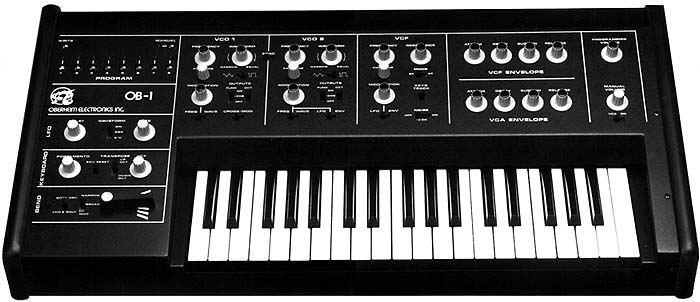
* I playd an Oberheim OB-1 again, and came to the same conclusions: very very beefy, with extra snarly filter. It's also really big? I guess you have to consider these things in context. In 1978, this thing was small, easy to gig with, etc. But compared to what we have now, it's a beast.
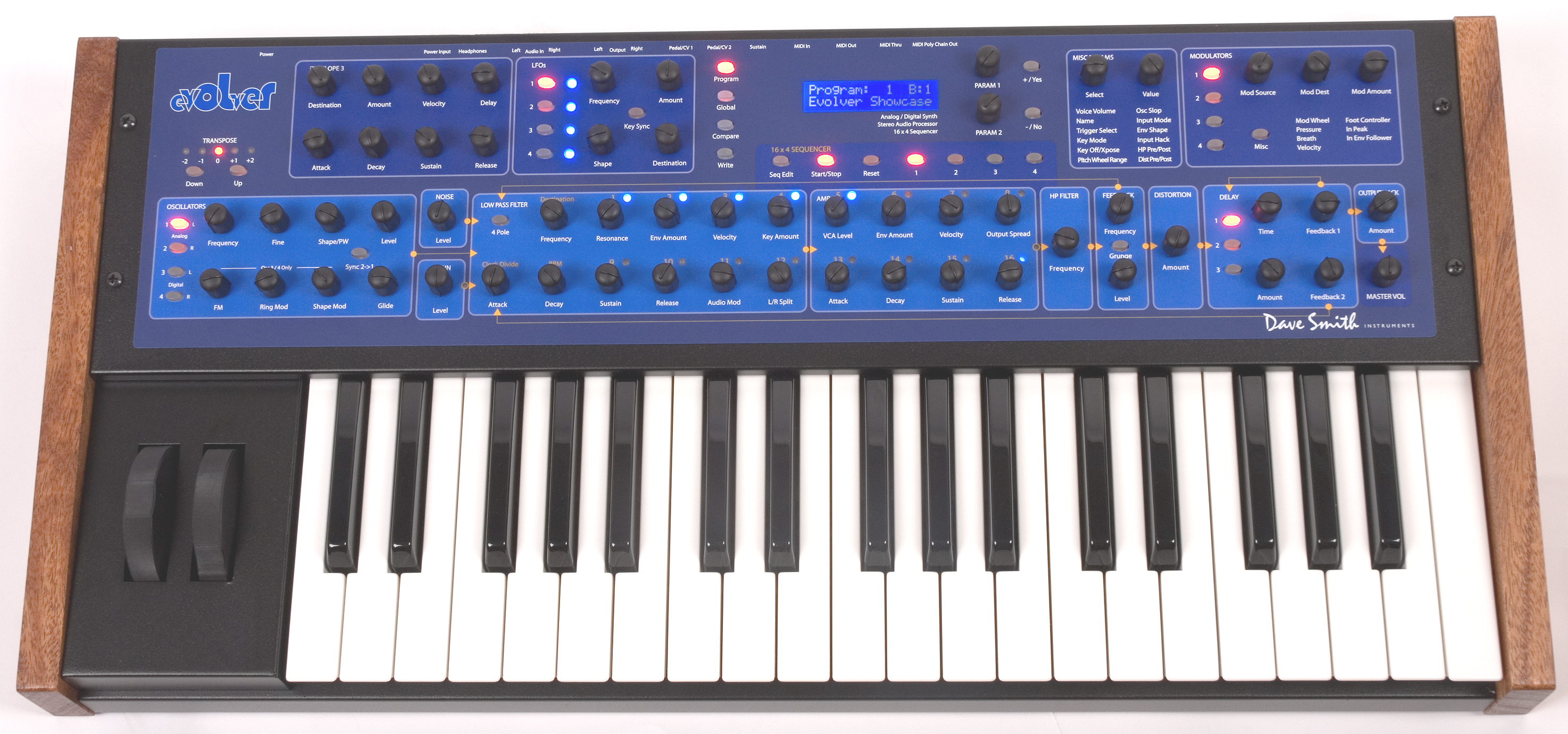
* I agree fully with Jason Proctor (formerly of the Lovemakers, for those of you on the FL who are fans), that the Dave Smith Instruments Mono Evolver Keyboard may be the most perfect monosynth ever made. Individual features of other synths are superior, but as an all in package, user interface, features, sounds, sequencer, blinky lights, and such, it rules. I am more convinced than ever to trade up from my tiny and useful mono desktop to the mono keyboard, if I can figure out where I would put it.
* People enjoyed the hell out of my modified sh-101 and fr-777, newly labled with crude Brother P-Touch labels, and their enjoyment completely validated all of my effort and expense.
* Speaking of, I put an oscilloscope on the 777, and those waves are NOT squares and saws. Hell no, not even close, rounded on the edges to hell and back. Also, the shape of the output wave with the resonance up?? If you think like me, it is *exactly* what you think it is, an half-arrow-tip shaped waveform made up of exponentially decaying sine partials. Watching and listening to the transformation as you bumped up the res was a complete gas, possibly warranting the purchase of a scope.
* Got to tweak a Roland system 100 model 101 keyboard (the bottom unit in the linked picture), it's very nice! Nice keyboard feel, sturdy as hell construction, smooth sliders, a rounder sound than the SH-101 (I think it is all discrete?), resonance is too controlled but at the high end it gets nice and chirpy. A winner, and now dammit, the one I played is for sale. It's not worth $700, though. I'm almost positive.
* Played with a Frostwave Fat Controller sequencer. Kind of sorry I didn't get one before he stopped making them.
* Finally, Eric Barbour of Metasonix, who built an entire company around low power, non-guitar-fetish-item vacuum tubes, brought the Wretch Machine, an all tube synth, which was only controllable from a Doepfer ribbon cable. Touch cable, get blasted by distortion. Turn knobs to warp distortion. He also had his new pedal, which will be called the Scrotum Squasher, and says on the side of it in big black letters, "Because your music sucks." It was all sick, and ugly, and twisted, not always in a good way, and some of you will want to own anything this guy makes. He grudgingly admits that you can plug a guitar into his products. Very grudgingly.
Too much fun for one afternoon, really; I can't wait until the next one.
* Robert Rich brought his wall of MOTM Modular. I mean, seriously, 8 x 12 feet of the stuff. He hands you headphones, and you hear the synthesized sound of two men, one with emphysema, shouting at each other from the third floor balconies of two buildings, in a heavy rainstorm, as heard by a homeless guy sitting in an alley wearing earmuffs. You are very impressed. Then he turns up the other 6 voices he has conveniently patched into the system, and goddamn, you are in New York. At 23rd and third. On a Thursday. Homeless, wearing earmuffs. He's pretty good, you know? You can hear the system I saw on the album _Bestiary_, although
askesis reminds me that Numena and Geometry are also quite good, and if you don't mind scary/disturbing music, his collaboration with Brian Lustmord, _Stalker_, will absolutely deliver The Fear. Robert's setup was literally the first thing I encountered upon arriving, and it put the rest of the event at a serious disadvantage. There were other highlights to be had, though.* I spent 25 minutes or so with a Matrix 12. The programming interface is not that complicated, but it is still more work than it should be and the modulation sources and destinations are far from obvious. Single voice sounds are your typical CEM chip timbre (3376 voice ; literally, a Matrix 6 sound. I crashed it once too, which was kind of strange; I can't remember the last time I actually crashed a music instrument. The whole point of the Matrix 12, it seems, is the multimode, where you can layer all 24 VCOs together. Short, Shameful Confession: despite its cool, Germanic temperament, I suspect that the Waldorf Q is a superior instrument in every way. I must admit that I did not dig into a Matrix 12 layered patch with 1, 2, 3, and 4 pole versions of the filter being swept about in different ways. I did confirm that the envelopes are too slow; you can't get a really booming kick out of them. On the other other other hand, the 25+ year old Matrix 12 had every knob and encoder still fully functional, which I cannot say about my 6 year old Q. It all comes back to the programming interface. The Q wins here by a mile.
* The new Buchla 200e is completely impenetrable. Which is to say, the interface has so many options, all of them named something non-obvious, that even experienced modular tweakers were flummoxed. The owner, in fact, showed an intriguing habit of plugging in control voltages, then reaching for multiple knobs and giving them wide sweeps; that tells me right away that despite owning the unit for 5 weeks or so, he still didn't know for certain which jack went with which knob to do what function! So he's reduced to frobbing blindly about until he hears a change, then zeroing in on what might be interesting. And make no mistake, the 200e can make some very very odd sounds, and the low pass gate (Buchla's version of a "filter") is a really weird noise shaper, but the system does not invite the user to interact with it. Which, given the almost total lack of design concessions towards playing straightforward tonal music, is a real flaw. Also...$10K-20K? Really?
* Why I will never work for People Magazine, thank God: In addition to Robert Rich and Eric Barbour of Metasonix (see below), apparently, both Don Buchla and Dave Smith (creator of the Prophet 5 and a dozen other vintage machines, currently manufacturing the Evolver, about which see below) were in attendance. That's me, too focused on knob-frobbery to clue into the very local opportunity for fawning sycophancy.
* The 30 year old EMS Synthi A and AKS, holy shit! The complete opposite of the Buchla. Only parts of it are impenetrable, like the alien intelligence part or the drunken howler monkey part :) The owner says to me, referring to the pair of them he brought, "you can't hurt them or break them, put the pins in the matrix wherever you like and don't worry about it." So I dialed up a long slow enveloped, ring-modded, two soft sync and one hard sync,trapezoid mangled monstrosity, with joystick control. Holy god. How does it know? It would sweep downwards in a most gnarly fashion, rippling with sync noises and other crosstalk, but at regular intervals it would spazz out, particularly at the turnaround points in the trapezoid cycle. How does it KNOW? The Ring mod was almost the sickest sound I heard all day (see Metasonix, below); the Q ring mod is a pale, pale comparison. One neat trick: you can patch up the joystick so that it gates the ring mod; that is, one direction sweeps one oscillator, the other direction sweeps the other oscillator, and any movement at all sends a gate signal to the trapezoid envelope. So you row the joystick, and damn! the note attack responds pretty much exactly like a cello! You get more, slower "bow scrape" on lower notes, and a certain harmonic richness increases slightly as the ring mod engages, mimicking the delayed resonance of the cello body. Karplus Strong synthesis, in 1970. Outstanding. There is no chance in hell of ever possessing one of these, which is probably a good thing, as I bet they go for a king's ransom.
* I know it's odd to think I hadn't seen one up close, but: I was surprised, the TR-808 is bigger than I thought. I knew this about the 909. Turn it on, and the 808 has The Sexy. I will not be denied; it is in your pants right now, etc. What a sound.
* Speaking of big, the Jupiter 4 is *huge*, at least in the vertical dimension. It looked like it was a foot thick. Kinda weedy sounding, though?
* Someone brought a Devilfish-modded TB-303, about which, ehh. With the modifications I have had done, my Future Retro FR-777 is twice the synth at half the cost and way easier to program. Me <-- happy!
* I playd an Oberheim OB-1 again, and came to the same conclusions: very very beefy, with extra snarly filter. It's also really big? I guess you have to consider these things in context. In 1978, this thing was small, easy to gig with, etc. But compared to what we have now, it's a beast.
* I agree fully with Jason Proctor (formerly of the Lovemakers, for those of you on the FL who are fans), that the Dave Smith Instruments Mono Evolver Keyboard may be the most perfect monosynth ever made. Individual features of other synths are superior, but as an all in package, user interface, features, sounds, sequencer, blinky lights, and such, it rules. I am more convinced than ever to trade up from my tiny and useful mono desktop to the mono keyboard, if I can figure out where I would put it.
* People enjoyed the hell out of my modified sh-101 and fr-777, newly labled with crude Brother P-Touch labels, and their enjoyment completely validated all of my effort and expense.
* Speaking of, I put an oscilloscope on the 777, and those waves are NOT squares and saws. Hell no, not even close, rounded on the edges to hell and back. Also, the shape of the output wave with the resonance up?? If you think like me, it is *exactly* what you think it is, an half-arrow-tip shaped waveform made up of exponentially decaying sine partials. Watching and listening to the transformation as you bumped up the res was a complete gas, possibly warranting the purchase of a scope.
* Got to tweak a Roland system 100 model 101 keyboard (the bottom unit in the linked picture), it's very nice! Nice keyboard feel, sturdy as hell construction, smooth sliders, a rounder sound than the SH-101 (I think it is all discrete?), resonance is too controlled but at the high end it gets nice and chirpy. A winner, and now dammit, the one I played is for sale. It's not worth $700, though. I'm almost positive.
* Played with a Frostwave Fat Controller sequencer. Kind of sorry I didn't get one before he stopped making them.
* Finally, Eric Barbour of Metasonix, who built an entire company around low power, non-guitar-fetish-item vacuum tubes, brought the Wretch Machine, an all tube synth, which was only controllable from a Doepfer ribbon cable. Touch cable, get blasted by distortion. Turn knobs to warp distortion. He also had his new pedal, which will be called the Scrotum Squasher, and says on the side of it in big black letters, "Because your music sucks." It was all sick, and ugly, and twisted, not always in a good way, and some of you will want to own anything this guy makes. He grudgingly admits that you can plug a guitar into his products. Very grudgingly.
Too much fun for one afternoon, really; I can't wait until the next one.


![[identity profile]](https://www.dreamwidth.org/img/silk/identity/openid.png)

Excellent post!
Date: 2006-11-24 08:51 pm (UTC)